I’ve mainly focussed on Vallance, partly because he was the Govt’s Chief Scientific Advisor and also co-Chair of SAGE (along with Whitty) but also because he’s had the most to say, and been the most clearly wrong in what he did say. But it’s also interesting to compare and contrast with other prominent members of SAGE. Prof John Edmunds is one such, I probably don’t need to show his horrendous TV interview of the 13th of March again but will do so anyway. It’s so endearing to see him sneering at Tomas Pueyo after the latter informs him correctly that the doubling time of the pandemic is about 3 days and a catastrophe is unfolding under out noses. No, he replies, you just don’t understand the data, the doubling time is really 5 days, and we mustn’t act too soon (go to 23:15 in the video):
In his recent testimony to the Inquiry, Edmunds says:
the surveillance system was poor, with the data being delayed and hard to interpret – so much so, that estimating the growth rate of the epidemic was difficult (estimates of the doubling time varied from about 3 days to about 5-7 days, depending on what method and data sources were used) and getting an accurate assessment of the overall size of the epidemic was also difficult. The delays and under-reporting (partly due to a lack of testing) might well have led decision-makers to conclude that they had more time to act than was the case.
It would have been more honest of him to say that his interpretation of the data was poor (along with the rest of SAGE) and this lead decision makers to believe they had more time to act. Furthermore, including the estimate of 3 day doubling in that comment above is particularly misleading, as SAGE was not acknowledging the legitimacy of such estimates at the time. Indeed he ridiculed the number when Pueyo suggested in on the evening of 13th March. But this post isn’t really about SAGE’s competence, it is just about establishing what SAGE actually did say at the time.
Edmunds then goes on to say:
Surveillance started to improve after the CHESS (‘COVID-19 Hospitalisation in England Surveillance System’) system was launched in hospitals on around 14-15th March, but it took a little while for the new data-stream to stabilise.
Here we see clear blue water between his testimony and that of Vallance. Remember, Vallance talks of SAGE members having a Road to Damascus conversion over the weekend of 14-15 March due to this new data becoming available. Edmunds does not repeat that claim, presumably because he knows it to be false. Perhaps he does not, however, contradict Vallance quite clearly enough for this contradiction to be obvious to a casual reader – or even those undertaking the Inquiry. He then rapidly passes on to the responsibility decision-makers had for deciding what to do. He admits that “It is certainly possible that had SAGE been earlier, clearer and more urgent in its advice then lockdown could have been introduced earlier.” “Earlier, clearer and more urgent” indeed. He could have added “correct“. But he didn’t.
I’ve sent the following letter to the Public Inquiry, noting the significant and repeated inconsistencies between what Vallance has recently testified about the events in mid-March 2020, and what the contemporaneous documentary evidence of that period actually says. This evidence includes, rather amusingly, Vallance himself in one of the daily PM statements and press conferences. I will of course post any response(s) received.
To: contact@covid19.public-inquiry.uk
To whom it may concern.
I have noticed a discrepancy between the witness statements made to the Inquiry by Sir Patrick Vallance concerning the events of March 2020, and documentary evidence from that period. It primarily concerns the estimation of the doubling time of the pandemic, which was of great importance in planning the policy response to it. The reason why this is important is that changing the estimate of doubling time from 5 days to 3 days would indicate that the problem was far greater, more urgent, and harder to deal with, than was previously thought. It would inevitably lead to an abrupt and urgent change in policy requirements. However, there is no evidence to support the claim made by Vallance that SAGE was calling for urgent and strict action from March 16 onwards, and that the Govt delayed action for a further week.
Vallance’s evidence to the UK Covid-19 Inquiry
To the Inquiry, Vallance stated that he, and other members of SAGE, changed their minds about the growth rate of the pandemic over the weekend of 14-15 March (bold emphasis added by me):
“I think the new understanding on the weekend of 14 and 15 March was that we were much further ahead in the pandemic than we realised, and the numbers that came in that week showed that there were many more cases, it was far more widespread, and was accelerating faster than anyone had expected.”
“We got information on 13 March which unambiguously showed that the pandemic was far more widespread and far bigger and moving faster than we had anticipated“
“The advice given on 18 March was a consequence of our concerns about the rapid doubling time and number of infections”
“A major reason SAGE did not advise earlier and more extensive interventions, for example on 10 March rather than 16 March, was that we were unaware of how widely seeded the virus was in the UK and how short the doubling time had become.”
“I am asked if the models underestimated the spread of the virus early in the pandemic. I think that they did, at least in terms of speed until shortly before the four day period of 13 to 16 March, which I discuss above. This was a function of poor and time delayed data and a consequent under-estimation of the virus’ doubling time.”
The conclusions that we are inescapably being asked to draw from these multiple statements is that (a) SAGE was underestimating the growth rate of the pandemic prior to the weekend of 14/15 March, but corrected their error at that time and (b) the correction of this error was critical in changing their advice from a measured program of mitigation to a much more urgent suppression of the pandemic.
Vallance’s evidence to the House of Commons Science and Technology Committee, July 2020
This mirrors the testimony Vallance gave previously to the House of Commons Science and Technology committee in July 2020:
“When the SAGE sub-group on modelling, SPI-M, saw that the doubling time had gone down to three days, which was in the middle of March, that was when the advice SAGE issued was that the remainder of the measures should be introduced as soon as possible.”
“The advice changed because the doubling rate of the epidemic was seen to be down to three days instead of six or seven days. We did not explicitly say how many weeks we were behind Italy as a reason to change; it was the doubling time, and the realisation that, on the basis of the data, we were further ahead in the epidemic than had been thought by the modelling groups up until that time.”
SAGE minutes of mid-March and other contemporaneous evidence
However, contrary to these claims, the minutes of the SAGE meeting on the 16th March very clearly stated:
“UK cases may be doubling in number every 5-6 days.”
and later that day, Vallance personally repeated the 5 day doubling figure live on TV:
“…the epidemic, you’d expect to double every 5 days or so…”
Two days later, the minutes of the SAGE meeting on the 18th March again stated:
“Assuming a doubling time of around 5-7 days continues to be reasonable, but this is before any of the measures brought in have had an effect; these measures are likely to slow the doubling time even if there is still an exponential curve.”
The first time 3 day doubling was hinted at in any official documentation appears to be the SPI-M-O meeting on the 20th March:
“Nowcasting and forecasting of the current situation in the UK suggests that the doubling time of cases accruing in ICU is short, ranging from 3 to 5 days.”
and this was finally endorsed in the SAGE minutes of the 23rd March:
“The doubling time for ICU patients is estimated to be 3-4 days“
It looks like Sir Patrick may have confused the weekends of 14-15 March, with 21-22 March. For example, the SPI-M meeting he referred to above as taking place prior to SAGE’s change of heart “in the middle of March” is actually documented as having taken place on the 20th March. I hope you will be able to contact him to ask him about these discrepancies.
At the very least, the documentary evidence proves that SAGE was still underestimating the growth rate of the pandemic right through their meetings of the 16th and 18th March, only finally correcting their error on the 23rd. But perhaps a more worrying implication here is that Sir Patrick’s recollection of SAGE’s approach towards mitigation and lockdown at this time is also in error. In fact, the minutes of the meetings of the 16th and 18th appear entirely supportive of the Govt actions at that time, which were to continue with the gradual extension of the measured program of (mostly voluntary) measures. On the 16th:
“SAGE cannot be certain that the measures being considered by HMG will be sufficient to push demand for critical care below NHS capacity but they may get very close under the RWC scenario.
While SAGE’s view remains that school closures constitutes one of the less effective single measure to reduce the epidemic peak, it may nevertheless become necessary to introduce school closures in order to push demand for critical care below NHS capacity. However school closures could increase the risks of transmission at smaller gatherings and for more vulnerable groups as well as impacting on key workers including NHS staff. As such it was agreed that further analysis and modelling of potential school closures was required (demand/supply, and effects on spread).”
and on the 18th:
“SAGE advises that the measures already announced should have a significant effect, provided compliance rates are good and in line with the assumptions. Additional measures will be needed if compliance rates are low.”
They even argued that the measures implemented on the 18th (including the new school closures) were probably adequate to fully suppress the pandemic:
“SAGE reviewed available evidence and modelling on the potential impact of school closures. The evidence indicates that school closures, combined with other measures, could help to bring the R0 number below 1, although there is uncertainty.”
Summary
The claims that the Govt was responsible for a week of delay at this time, and that SAGE was arguing for much more immediate and stringent action, is not supported by a reasonable reading of the evidence. Indeed, SAGE had no reason to be doing this, since they still believed (contrary to Vallance’s testimony above) that the pandemic was doubling at a rate no more rapidly than 5 days (at worst) and furthermore, as they explicitly stated on the 18th, was probably being significantly slowed beyond this figure by existing policies already introduced at that time.
All of the quotations I have given above are directly copied from official documentation available on the Govt’s own web site, other than that taken from the youtube video of the PM statement and press conference of the 16th March which is my own transcription. Please contact me if you require any help in validating the provenance or accuracy any of this evidence.
One thing that all the protagonists (myself included) agree on is that SAGE’s estimate of doubling time in mid-March was of critical importance. Vallancetestified forcefully to this effect in 2020:
When the SAGE sub-group on modelling, SPI-M, saw that the doubling time had gone down to three days, which was in the middle of March, that was when the advice SAGE issued was that the remainder of the measures should be introduced as soon as possible.
And then confirmed in this exchange with a committee member:
Sir Patrick Vallance: Knowledge of the three-day doubling rate became evident during the week before.
Q1080 [ed – this number has changed from the previous time I posted about this] Graham Stringer: Did it immediately affect the recommendations on what to do?
Sir Patrick Vallance: It absolutely affected the recommendations on what to do, which was that the remaining measures should be implemented as soon as possible. I think that was the advice given.
and again:
Sir Patrick Vallance: The advice changed because the doubling rate of the epidemic was seen to be down to three days instead of six or seven days. We did not explicitly say how many weeks we were behind Italy as a reason to change; it was the doubling time, and the realisation that, on the basis of the data, we were further ahead in the epidemic than had been thought by the modelling groups up until that time.
But why does the doubling time matter so much, and is the difference between 3 days and 5 day really important? The point of this post is to answer these questions.
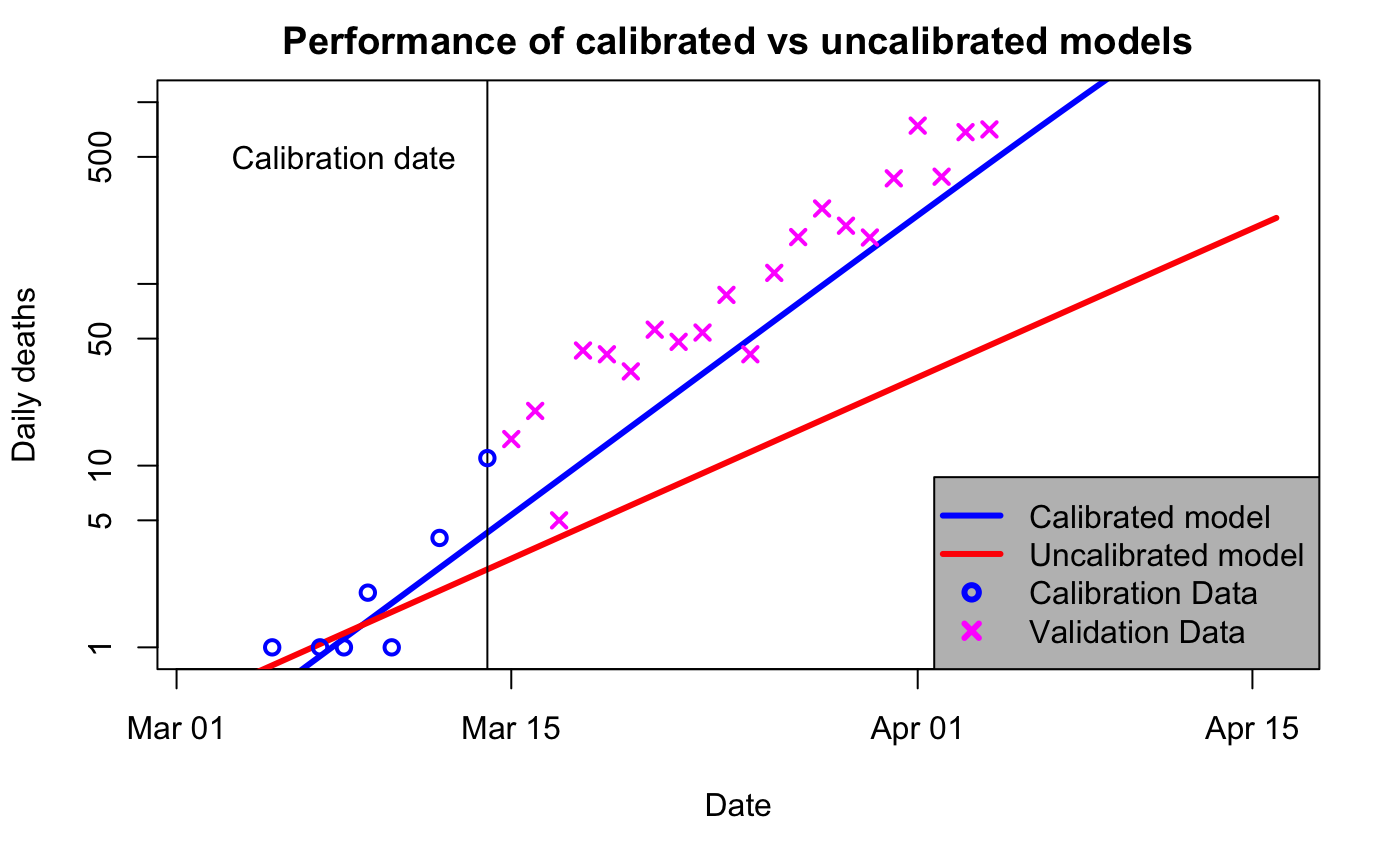
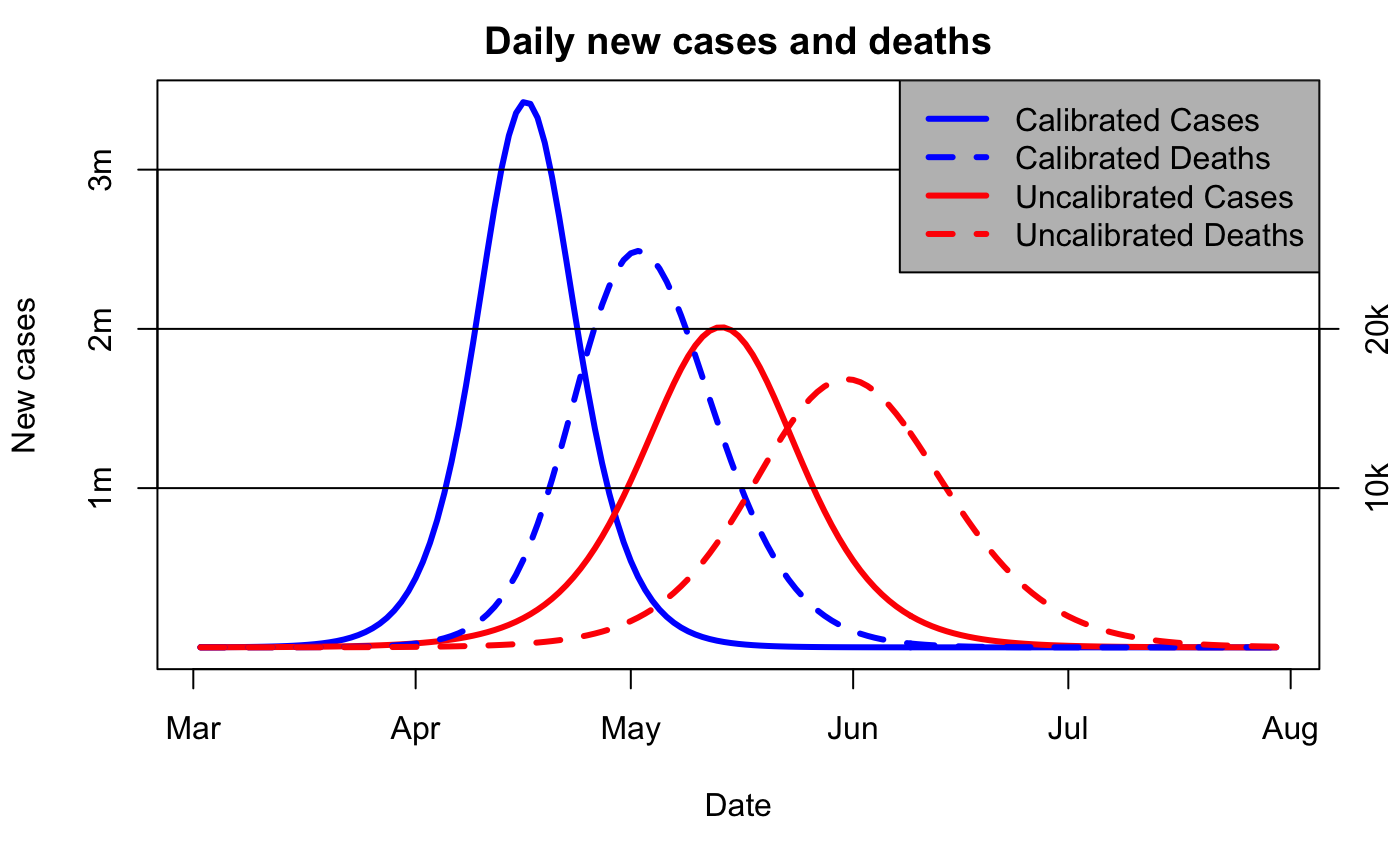
I’ll start by repeating a couple of plots I first made way back in April 2020 when it was just dawning on me what a colossal cock-up SAGE had made of it. These graphs are generated by a simple SEIR model that I’ve shown to reasonably replicate more sophisticated ones. In the below, the blue “calibrated” line uses data up to 14 March to estimate doubling time, which comes out at 3 days. The red “uncalibrated” line uses parameters from Ferguson’s March 16 paper, which has a doubling time of 5 days.
So, one obvious point is that the blue curve does a much better job of predicting what was going to happen (ie, the magenta x, which were not used to calibrate either model). But that’s not the point of this particular post. Rather, it’s just that the predictions for 3d vs 5d doubling are radically different. Here is the longer-term view, now without the logarithmic scaling on the axis:
Note the “we are here” point is mid-March, when the red and blue curves are visually indistinguishable.
There are several reasons why the doubling time matters. Firstly, the estimate of current pandemic size is based on historic data. Edmunds specifically talks of a 12 day delay from infection to illness, to testing, to finally test data reporting. So 100 cases reportedtoday means 100 infections 12 days ago, and that’s 4 doublings at 3d doubling, meaning 1,600 cases now. If the doubling time was only 5d, then the 12 day delay is just over 2 doublings, and we wouldn’t be at 1,600 cases for another 8 days (4 doublings is 20 days, so that means 12 just past and another 8 in the future). So one immediate consequence of a change in perceived doubling time is that we’ve lost just over a week in terms of pandemic progression. (These calculations all ignore the proportion of infections that are undetected, which can reasonably assume to be roughly constant and thus not affect the argument.)
Secondly, the 3d doubling means the pandemic comes much sooner, and (thirdly) reaches a much higher peak, as shown in the 2nd graph above. What was expected some time over the summer, is now happening next month, and it’s going to be a lot worse than expected – getting on for twice as many cases per day at peak.
Finally, the more rapid doubling implies a higher R0-number, and this makes it harder to control. With R0=2.4 (Ferguson’s 16 March number), a reduction of contacts to 40% of normal would control the virus, because 2.4 x 0.4 = 0.96 which is less than 1. Whereas a 3d doubling implies a rather higher R0, let’s say 3.2. This then requires much stiffer action, because 3.2 x 0.4 = 1.28 which is still greater than 1. A reduction to 30% of previous contact levels to get the R number below 1 (3.2 x 0.3 = 0.96 as before) is obviously much tougher to achieve especially given that family members, essential work etc mean we can’t really isolate perfectly. (Quibbling over the exact value of R0 to use doesn’t invalidate the general point that a higher R0 is harder to control.)
So, changing the estimate of doubling time from 5d to 3d would be a real “oh shit” moment for anyone involved in pandemic planning. It means (a) we’ve instantaneously lost 8 days of lead-time, (b) the pandemic peak is going to be coming a month sooner than expected, (c) the peak is going to be almost twice as big as expected, and (d) the control measures we were hoping to use are much less likely to be adequate. Any plan predicated on a 5d doubling time would immediately have to be revisited in the most extreme and urgent manner.
I hope I have convinced my reader that whatever plans were in place in early March under the assumption of a 5 day doubling, the new understanding that the doubling time was instead 3d would cause an abrupt and substantial change of perspective. This, from a scientific perspective, is inevitable and obvious.
Ok I’m going to do a bit of analysis of Vallance’s evidence to the UK Covid-19 Inquiry, focussing specifically on the events of the mid-March 2020 period up to the imposition of the first “lockdown” on 23rd March. On Monday 20th Nov 2023 he was interviewed by the Inquiry and also provided some written testimony. This is broadly speaking a more detailed version of the testimony he provided back in July 2020 to the House of Commons Science and Technology Committee (whichI blogged about at the time) but appears significantly inconsistent with the documentary evidence provided by the minutes of SAGE meetings and other records of that period. If you already agree with me that Vallance misled the S&TC with his testimony in 2020 then you might not find this very interesting, but I think I might as well go over it again as there’s a lot more testimony to consider (including other participants in SAGE).
I’ll break it up into sections in order to make it digestible, and also to avoid me going round in ever decreasing circles. To start with, let’s consider some background concepts…
This module will look at, and make recommendations upon, the UK’s core political and administrative decision-making in relation to the Covid-19 pandemic between early January 2020 until February 2022, when the remaining Covid restrictions were lifted. It will pay particular scrutiny to the decisions taken by the Prime Minister and the Cabinet, as advised by the Civil Service, senior political, scientific and medical advisers, and relevant Cabinet sub-committees, between early January and late March 2020, when the first national lockdown was imposed.
I’m particularly interested in this period, as it’s the time that the expert scientific analysis and advice from SAGE was so woefully inadequate. I’ve blogged about this at length, but just to recap, the scientists were mistakenly thinking that the doubling time of the pandemic was about 5-6 days (various numbers appear in the SAGE minutes) and that we shouldn’t take too stringent measures as there was a genuine risk that by doing so we’d put the pandemic off to the following winter when it would add to the normal seasonal pressures on the NHS. They were quite anxious that we should get through it over the summer of 2020 instead.
Vallance misled the Science and Technology Select Committee a while ago about this, claiming that SAGE had recommended lockdown on the 16th or 18th of March. This is contradicted by the minutes of those meetings, and even if you try to argue that the minutes may not be completely definitive on that, it is also contradicted by his accompanying statement that their change of heart was due to correcting their estimate of the doubling time (to 3 days), which the SAGE minutes document very precisely to the 23rd March. He’s due to give evidence to the UK Covid-19 Inquiry on Monday, so I await with interest to see whether he will correct the record or also mislead them.
This error was not just an inconsequential comment in a committee that no-one cares about, but has been widely reflected in press comment. For example, the usually excellent Lewis Goodall on Xitter:
Doesn’t seem to me that what @uksciencechief said earlier has received as much attention as it should, in the day’s tsunami of news. In saying that SAGE advised the govt to lockdown a week earlier than they did, yet more space is opening up between them. pic.twitter.com/cKuWXlh7vH
I can see I’m going to have to go over all this again. It’s not a task I really face with much enthusiasm, but it doesn’t seem like anyone else is prepared to do it. To say I’m disappointed at the revisionism, sleight-of-hand and downright misleading testimony from several senior scientists to the UK Covid-19 Inquiry would be an understatement. I had naively hoped there might be some element of humility, introspection and self-reflection concerning their errors at the start of the outbreak, but I’ve seen no hint of this. (If anyone wants to reassure me that lessons have been learnt internally, then I’m all ears, but would want to see evidence of this.)
Unfortunately, neither the inquisitors themselves, nor the journalists following the process, nor the array of commentators eagerly quoting the juicy messages, seem to have the will or perhaps the scientific skills to unpick the story. That’s not to say it is hugely complicated, but a basic understanding of the underlying mathematics is vital for piecing together how it all played out, and why. And it’s very clear that most people start out with an agenda and go looking for support, rather than really being interested in understanding the truth. The scientists are delighted to have found a route to blaming the politicians, and the politicians are too focussed on knifing each other to question what the scientists are now claiming the history to be.
That’s not to say I’m perfect (far from it), but on this particular topic, I happen to be correct. A more difficult question, is whether anyone else cares. Anyway, on with the show….
As you may have noticed, there hasn’t been a lot of science getting done here recently.
The basic reason for this is that we’ve decided to retire and close down Blue Skies Research Ltd. We set it up about 10 years ago, when we returned from Japan, and have had a lot of fun continuing our research in a private setting but over the last few years have been gradually winding down the research activity and increasing the other-than-research activity and want to focus on the latter from now on.
There’s a paper in the works with paper charges still to pay so the company isn’t completely shut down yet. We aren’t looking for new projects but if something exciting comes up, we might change our minds.
To be honest, we haven’t been particularly inspired by new ideas for a while and simply don’t have any burning climate science questions that we need to answer. After all, we have worked out what Equilibrium Climate Sensitivity is (actually we worked it out in 2006, but everyone else took 15 years to catch up). There are lots of other scientists quite capable of taking the field wherever they choose to, and we look forward to seeing where they go!
Many years ago, I played chess as a schoolboy. Not all that brilliantly, but good enough for the school team which played in various competitions. This fell by the wayside when I went to university, and I'd never had the time or energy to re-start though kept on playing against my uncle when we met. A couple of years ago during covid lockdowns I started playing on-line on chess.com, and then more recently someone started a chess club in Settle where a small bunch of us have been playing fairly informal and quick games. Last weekend was my first proper over-the-board competition, at the very conveniently located Ilkley Chess Festival. I'd naively assumed this would be a local event for local people, but my opponents came from all over, hailing from Portsmouth, Nottingham, Shrewsbury, and even Scarborough. There were also some Scots on the entry list that I didn't meet.
I've blogged the event on the chess.com site (here and here) as that allows for embedding of games. Spoiler alert: after losing the first game, I won the next 4, ending in 4th place. In the “Intermediate” section, which means under-1750 rated. (I don't have a current rating for OTB chess, so had to guess which section to enter. At school I was about 1450.)
Someone was taking pictures, so here is a picture of the main hall:
I haven’t blogged in ages but have actually done a bit of work. Specifically, I eventually wrote up my new reconstruction of the Last Glacial Maximum. We did this back in 2012/3 (see here) but since then there have been lots more model simulations, and then in 2020 Jessica Tierney published a new compilation and analysis of sea surface temperature proxy data. She also produced her own estimate of the LGM temperature anomaly based on this data set, coming up with -6.1±0.4C which seemed both very cold and very precise compared to our own previous estimate of -4.0±0.8C (both ranges at 95% probability).
We thought there were quite possibly some problems with her result, but weren’t a priori sure how important a factor this might have been, so that was an extra motivation to revisit our own work.
It took a while, mostly because I was trying to incrementally improve our previous method (multivariate pattern scaling) and it took a long time to get round to realising that what I really wanted was an Ensemble Kalman Filter, which is what Tierney et al (TEA) had already used. However, they used an ensemble made by sampling internal variability of a single model (CESM1-2) and a few different sets of boundary conditions (18ka and 21ka for LGM, 0 and 3ka for the pre-industrial), whereas I’m using the PMIP meta-ensemble of PMIP2, PMIP3, and PMIP4 models.
OK, being honest, that was part of the reason, the other part was general procrastination and laziness. Once I could see where it was going, tidying up the details for publication was a bit boring. But it got done, and the paper is currently in review at CPD. Our new headline result is -4.5±1.7C, so slightly colder and much more uncertain than our previous result, but nowhere near as cold as TEA.
I submitted an abstract for the EGU meeting which is on again right now. It’s fully blended in-person and on-line now, which is a fabulous step forwards that I’ve been agitating for from the sidelines for a while. They used to say it was impossible, but covid forced their hand somewhat with two years of virtual meetings, and now they have worked out how to blend it. A few teething niggles but it’s working pretty well, at least for us as virtual attendees. Talks are very short so rather than go over the whole reconstruction again (I’ve presented early versions previously) I focussed just on one question: why is our result so different from Tierney et al? While I hadn’t set out specifically to critique that work, the reviewers seemed keen to explore, so I’ve recently done a bit more digging into our result. My presentation can be found via this link, I think.
One might assume a major reason might be that the new TEA proxy data set was substantially colder than what went before, but we didn’t find that to be the case. In fact many of the gridded data points coincide physically with the MARGO SST data set which we had previously used, and the average value over these locations was only 0.3C colder in TEA than MARGO (though there was a substantial RMS difference between the points, which is interesting in itself as it suggests that these temperature estimates may still be rather uncertain). A modest cooling of 0.3 in the mean for these SST points might be expected to translate to about 0.5 or so for surface air temperature globally, not close to to the 2.1C difference seen between our 2013 result and their 2020 paper. Also, our results are very similar when we switch between using MARGO and TEA and both together. So, we don’t believe the new TEA data are substantially different from what went before.
What is really different between TEA and our new work is the priors we used.
Here is a figure summarising our main analysis, which follows the Ensemble Kalman Filter approach, which means we have a prior ensemble of model simulations (lower blue dots, summarised in the blue gaussian curve above) each of which is updated by nudging towards observations, generating the posterior ensemble of upper red dots and red curve. I’ve highlighted one model in green, which is CESM1-2. Under this plot I have pasted bits of a figure from Tierney et al which shows their prior and posterior 95% ranges. I lined up the scales carefully. You can see that the middle of their ensembles, which are entirely based on CESM1-2, are really quite close to what we get with the CESM1-2 model (the big dots in their ranges are the median of their distributions, which obviously aren’t quite gaussian). Their calculation isn’t identical to what we get with CESM1-2, because it’s a different model simulation, with different forcing, we are using different data and there are various other differences in the details of our calculation. But it’s close.
Here is a terrible animated gif. It isn’t that fuzzy in the full presentation. What it shows is the latitudinal temperatures (anomalies relative to pre-industrial) of our posterior ensemble of reconstructions (thin black lines, thick line showing the mean), with the CESM-derived member highlighted in green, and Tierney et al’s mean estimate added in purple. The structural similarity between those two lines is striking.
A simple calculation also shows that the global temperature field of our CESM-derived sample is closer to their mean in the RMS difference sense, than any other of our ensemble members. Clearly, there’s a strong imprint of the underlying model even after the nudge towards the data sets.
So, this is why we think their result is largely down to their choice of prior. While we have a solution that looks like their mean estimate, this lies close to the edge of our range. The reason they don’t have any solutions that look like the bulk of our results is simply that they excluded them a priori. It’s nothing to do with their new data or their analysis method.
We’ve been warning against the use of single model ensembles to represent uncertainty in climate change for a full decade now, it’s disappointing that the message doesn’t seem to have got through.